Paradigm shift in the understanding of the effect of hyaluronic acid fillers?
Paradigm shift in the understanding of the effect of hyaluronic acid fillers?
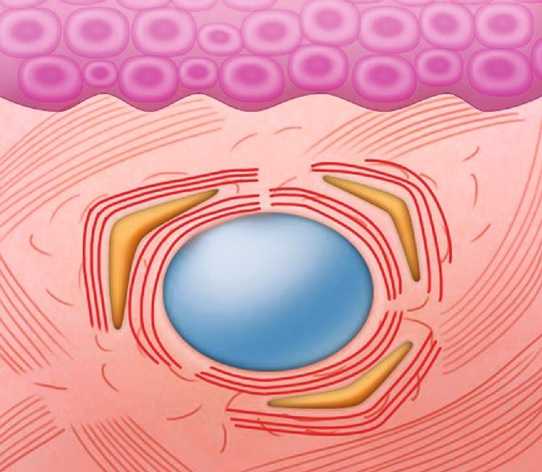
It is well established that subcutaneous injection of hyaluronic acid fillers leads to changes in the extracellular matrix.
For example, in vitro studies with human fibroblasts have shown that the synthesis of type I collagen is promoted. In the mouse model, dermally injected hyaluronic acid promotes collagen I and elastin synthesis via the TGF-β/Smad signalling pathway. Furthermore, after injection of a dermal filler, increased collagen (approx. 2x), elastin (approx. 6.5x) and fibronectin (approx. 2.6x) were found in skin biopsies taken after 12 weeks, compared with NaCl injection. In addition, more CD31-positive cells were found (approx. 3.7x), which points to promotion of angiogenesis. A study from Italy was likewise able to show increased activity of dermal fibroblasts with synthesis of type III collagen, and promotion of angiogenesis and of epidermal thickness.
Nevertheless, it must be noted that robust, randomised and controlled clinical studies are lacking to clarify whether this is of relevance for clinical use.
In a recently published review (Wollina & Goldmann, Hautarzt 2021 · 72:403–407), the two authors examine the effect of hyaluronic acid fillers on the extracellular matrix from a new perspective:
Wollina and Goldmann theorise that although hyaluronic acid fillers are able to activate fibroblasts, this is of minor relevance for the lasting effects.
The two authors theorise that hyaluronic acid serves as a matrix for somatic stem cells, including preadipocytes (precursor cells of adipocytes). Degradation of hyaluronic acid reduces the ability of preadipocytes to develop into mature adipocytes (cells of adipose tissue). Furthermore, it has been shown that hyaluronic acid substantially promotes the proliferation of preadipocytes and reduces the senescence of adipocytes. In addition, cross-linked hyaluronic acid stabilises mature adipocytes and slows basal and isoproterenol-induced lipolysis. Interestingly, it has also been demonstrated that subcutaneous injection of human preadipocytes in a hyaluronic acid matrix leads to the formation of new, mature adipose tissue in immunodeficient mice.
The study results suggest that the long-term volume effects observed deep in the midface after hyaluronic acid injection are the result of stem cell induction in the facial adipose tissue. What is decisive here is exactly where in the facial adipose tissue the hyaluronic acid filler is injected. High preadipocyte counts are present particularly in the deep midfacial fat compartment.
|
Conclusion
Careful selection of injection techniques and hyaluronic acid preparations can help to achieve long-term effects (particularly in volume restoration of the midface). Further developments are to be expected in the future, such as the targeted development of hyaluronic acid fillers that specifically stimulate interaction with somatic stem cells (including preadipocytes) of the adipose tissue.
|
Source:
U. Wollina and A. Goldman. Hautarzt 2021 · 72:403–407