Hyaluronidase in aesthetic medicine - new treatment algorithm
Hyaluronidase in aesthetic medicine - new treatment algorithm
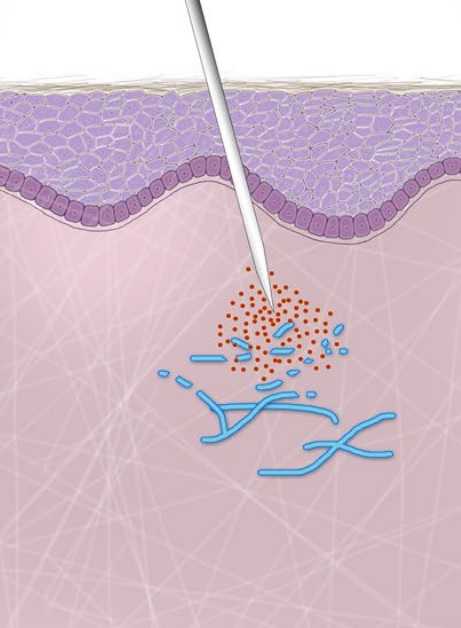
In addition to its classic use in ophthalmic surgery, the enzyme hyaluronidase, used off-label, continues to prove itself in aesthetic medicine as the gold standard and emergency medicinal product for dissolving injected hyaluronic acid. Hyaluronidase is an enzyme that cleaves hyaluronic acid by hydrolysis. In an emergency, externally administered hyaluronidase can thus dissolve the material when too much hyaluronic acid has been injected or it has been injected incorrectly.
To date, there are no official guidelines on the use of hyaluronidase in the management of complications with hyaluronic acid fillers. In the recently published clinical study by Rouanet et al. (2021) with 35 patients, the authors propose a new treatment algorithm with repeated high doses of hyaluronidase:
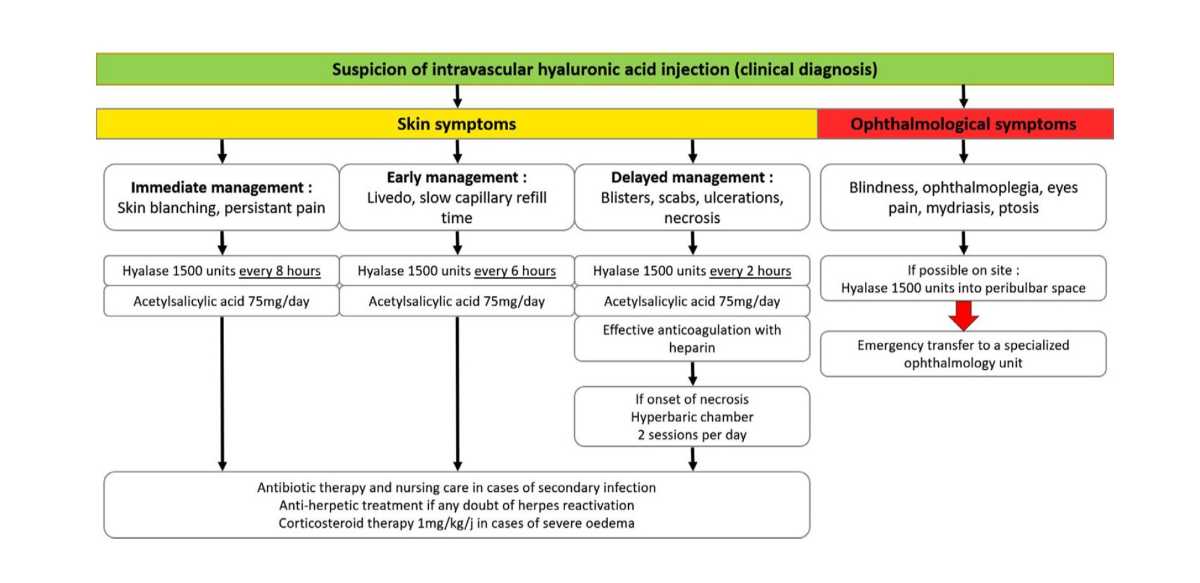
Fig. 1: Hyaluronidase protocol for the treatment of vascular complications caused by hyaluronic acid fillers
Dosage
The consensus today is that, in the event of an embolism, high doses of hyaluronidase should be injected repeatedly until the hyaluronic acid has completely dissolved. The authors C. Rouanet, P. Kestemont, C. Winter et al. consider 1,500 units of Hyalase® (Negma, Elancourt, France) to be appropriate for a rapid and efficient effect. An improvement in the clinical picture can generally be expected within 24 hours. Usually, 3–4 injections of hyaluronidase are sufficient in cases of early diagnosis and mild symptoms (and rather superficial skin complications). For more serious complications, 8–9 injections are more appropriate. It should be mentioned here that the preparation generally has a good safety profile and shows a low rate of adverse effects even at high doses. According to current knowledge, overdoses have not been documented. The prevalence of hypersensitivity reactions is 0.1%−1%. Particularly when urgent action is needed, prior allergy testing is therefore not absolutely necessary.
Time window
High efficacy of hyaluronidase has been demonstrated particularly when it is injected within 4 hours of the onset of a complication. However, treatment is still worthwhile even after 24 hours: the extent of the ischaemic area is reduced and healing is promoted. The authors therefore recommend initiating treatment as early as possible and for as long as the skin necrosis has not reached a total state.
What else?
As a supplement, the authors recommend adding acetylsalicylic acid (75−325 mg/day) to prevent the formation of blood clots and reduce the degree of inflammation. In the case of superinfections, oral antibiotic therapy and local skin care and therapy are advised. Regular follow-up should be a matter of course.
If total necrosis is present, the necrotic tissue should be removed and daily dressing care subsequently initiated. In this case, both the practitioner and the patient must be aware that the healing process is protracted and that negative aesthetic implications are to be expected.
According to the present publication, further strategies (whose efficacy has not been clearly demonstrated) include anticoagulant therapy and hyperbaric oxygen therapy (HBO). HBO can be applied once or twice daily to reduce the severity of ischaemia and tissue loss.
Source:
C. Rouanet, P. Kestemont, C. Winter et al. C. Rouanet, P. Kestemont, C. Winter et al. Journal of Stomatology oral and Maxillofacial Surgery 00 (2021) 1−4